Monday, February 16, 2015

Computation Intervention {with The Primary Gal}


Please tell me that I'm not alone in wondering where to begin with test preparation.  Do you start with the basics such as computation?  Problem solving?  Technology skills?  Ahhhh!  It can be overwhelming and time is so precious.  Prior to Christmas break, I began to think about what routines I have in place as well as what I need to implement during the spring semester to ensure that my students were prepped and ready for that dreaded test. 


I like to use daily routines for spiral review to ensure that students are being repeatedly exposed to grade level content.  Each day, I lay out one card with a computation problem.  Students have ONE shot at getting this answer completed correctly.  They must show all of their work in order to receive credit.  I have a rotation in which I use for the problems each day based on the weaknesses that I am seeing with my students.  I am currently rotating through adding, subtracting, multiplying, and dividing fractions, as well as basic multiplication and division.  We have completed five rounds with this set of skills and I am getting ready to rock their world when I move to harder material such as adding, subtracting, multiplying, and dividing mixed numbers, as well as multiplying and dividing decimals.


I allow my students to complete this problem at any time throughout the morning and I begin checking their answers during study hall (12:00-12:30).  Obviously, I cannot display my student data in a picture but this is similar to what I do.  If they have the problem correct, I place a check next to their name. As they return their practice pages the following day, I put a star next to their name.  At a quick glance, I can see who consistently answers problems correctly (checks), incorrectly (stars), or does not complete homework (completely blank).


For students who do not correctly answer the question, I give them a coordinating practice page for homework.  I love this intervention because it targets only the students who need the practice without taking away precious class time.  Each page includes a QR Code that allows the students to check their own work before turning it in.


So here is the data!  I am slightly embarrassed with my first round numbers.  Out of 37 students, in my first round through basic computation, I had MANY errors.  Many of them were just simple errors while a few students were TOTALLY off track.  Either way, they received twelve additional problems for homework that evening.  By round three, I was extremely happy with their progress and feel that the additional practice has been an effective way for making sure that students are mastering these computation skills without taking away time from other review and test prep.

I had a parent question why I was using ONE question to determine if they needed additional homework on that particular skill.  My justification is that there may only be ONE problem on high stakes testing that determines if they know how to complete this skill.  I need them to be able to demonstrate in ONE problem what they can do and do it accurately.  It also encourages students to SLOW DOWN.  I often remind them that it makes more sense to take your time on that one problem than to rush through and receive additional homework.


By clicking the image above, you can grab my Computation Intervention Club or choose custom products to build an intervention plan that will help your students the most.  


Sunday, February 15, 2015

Rockin' the Test with Less Stress on Teachers AND Students!


If you’re a teacher in grades 3 and up, you’re probably approaching (or maybe you’re already there) that dreaded crunch time before state testing arrives. This time is typically accompanied with anxiety, tension, and stress for both students and teachers.

What makes standardized testing so stressful? Maybe it’s the actual method by which they are administered?
  1. They are rigidly timed.
  2. Instructions are complicated.
  3. Rules are inflexible.
  4. The room is completely rearranged.
  5. Day-to-day life in the classroom is interrupted.

These are all things that (at this point) are out of our control. So, until a law is passed with less emphasis on high-stakes testing, we must find a way to muddle through the mess, calm our nerves (and student’s nerves), and ease the stress of testing. There’s many ways to do this as teachers.

When it comes to testing we want our students to perform well. We know that scores will be analyzed, published in newspapers and on websites, and banners will be given to exemplary schools. Teachers are even analyzed based on “their” test scores. We know that this can in turn affect our teaching position for the following year, or even worse – our paycheck! Naturally this brings about a high degree of stress on teachers.

How can we, as teachers, limit that stress?


Create a Positive Atmosphere

One thing I’ve learned in 14 years of teaching is that my students can read me pretty well. They know when I’m in a bad mood. They know when I’m tired. They know when they should be on their best behavior. They know when I’m stressed out! These feelings and emotions I have in the classroom affects my students.

Create an atmosphere in your classroom that makes students feel at ease. Praise them for their hard work. Encourage them with words like, “You’ve got this,” or “You can do this.” Reassurance goes a long way - especially when it’s coming from their teacher. Remaining calm and friendly will help ease their nerves. It’s important that your students not see you upset or worried (even if you are).

Get students excited!

Yes, I know…excited about taking a test? Excited about taking a 3 hour test? What student gets excited about that? Well, the reality is, standardized testing is not going to go away (or at least not anytime soon), so we might as well try to make it as enjoyable as possible for students. Give your students magic pencils or special stickers to wear. Before the test, allow your students to show off how smart they are by playing review games and competing against each other in class.

In my classroom, students get special testing “treats” on their desk each day of testing. For example, I might leave a note on each student’s desk that says, “You’re one smart cookie!” with a few cookies for a snack, or “You can lick this test!” with a sucker attached. On the last day, I like to leave a note that says, “This test is o-fish-ally over!” with a bag of Goldfish Crackers. We typically test for 3-4 days straight, so my students love coming in each morning to see what special treat I’ve left them that day. By doing this I transform anxiety into excitement!


Practice, Practice, Practice!

Not knowing what to expect naturally evokes fear and anxiety – especially in children. Practice taking similar tests before the “REAL” test. Follow through with testing protocol just as if students were taking the big test. Allow students time to practice bubbling answers (since this is not typically how we assess students throughout the year). Practice time management, by administering the test with time limits. Giving students the opportunity to experience this different way of testing will ease their fears, and they will know exactly what to expect come testing day.


Involve Parents!

Inform parents about the test, when it will be administered, and what they can do at home to help ease the stress of testing for their child. Simple tips for parents like – going to bed early, eating a healthy breakfast, and encouraging their child to do their best – can go a long way!

Along with keeping my parents informed about testing, I also send home a special letter and blank note. I ask parents to write a letter on the blank note encouraging their child to do their best. In my letter I instruct them to send the note back with a picture that’s special to their child. During testing days, I display each note and picture on a bulletin board in our classroom. Sometimes I receive family pictures, pictures with a child and their pet, or pictures with grandparents. It always varies, but the notes and pictures serve as a reminder to each child that they have support and encouragement from home as well. They love reading the notes and looking at the pictures. They can visually see how much support they have from home just by glancing at the bulletin board. 


Relax!

As I said before, test anxiety and stress doesn't just occur in students.  WE (teachers) feel it, too. You've no doubt done an excellent job to prepare your students for this day. Now, let them do their job to show off what they have learned. Most (notice I said “most”) students want to please their teacher and parents. We have to hope that students will take the test(s) seriously, but it’s easy to play through scenarios in our mind. What if they don’t look back for the answers? What if they don’t work out the math problems? What if they don’t finish in time? Is there REALLY anything we, as teachers, can do about it? As I like to say, “It is what it is.” Stressing about it gets us nowhere, but of course that’s sometimes easier said than done. (By the way, I’m preaching to the choir here.) J The most important part is relaxing and remaining calm around our students. A student’s anxiety can be contagious, but it will be easier to get them to relax if you’re relaxed!

Above I mentioned the special desk treats and parent letters I display on a bulletin board in my classroom.  Below, you will find my testing treat tags (treats not included – sorry), and a copy of the letter and blank note I send home to students. This product is available in my storeClick on the images for a closer look!


Best of luck with testing, and don’t worry – Your students are going to do great! More times than not, they surprise us!

Wednesday, February 11, 2015

Rockin' the Test with Task Cards!

It wasn't until last year that I discovered Task Cards.  Sad, isn't it?  These sweet little babies have stolen my heart and I just can't get enough of them.  Why, you ask?  Well, they are perfect for practice and review, particularly when you want to make sure your students are ready for the big test day. Not only that, but they are extremely versatile, and I can trick my students into thinking they are playing games when they are actually reviewing skills.  Clever, right?

With such a great emphasis on high-stakes testing, I need to make practice and review as fun and enjoyable as possible. I certainly do not want to add any extra stress to my students' plate by emphasizing the upcoming test so often and so emphatically that they begin to glaze over, tune me out, and wish they were anywhere at all except for my classroom.

Here are some ways to use task cards to help prep your students for testing time in a fun, enjoyable, and meaningful way:

1.  Create a Task Card Center.  Simply place the task cards for the skill you want to review into a pocket chart and you have an instant Math Center.


You can also be creative in how you display them. I used mini clothespins on this cute frame I found at Hobby Lobby awhile ago. Adorable and functional! Score!


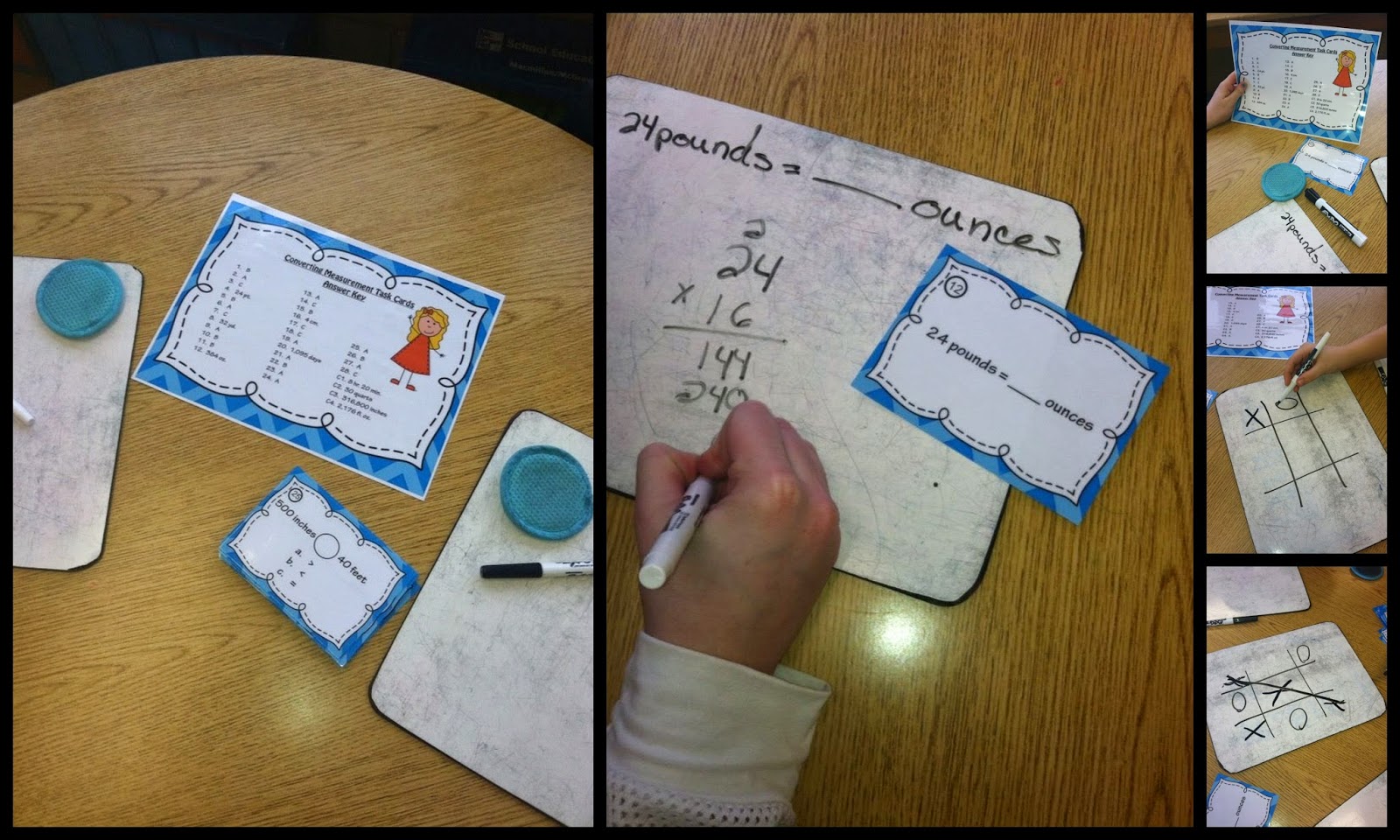
2.  Use Any Board Game.  Students love games like Connect 4, checkers, and Jenga.  So let them earn a turn in the game by correctly answering a task card question. First, provide dry erase boards, markers, and erasers for each player.  (I find it easiest to have students working in pairs.) Then, give them a stack of task cards for whatever skill you are reviewing. Have students work independently on their own dry erase boards to solve the problem on the top card.  Then, have them turn over the answer key and check it.  If they are correct, they get to take a turn in the game. If not, they lose a turn.  Students really do love this practice method!


3.  Use Building Blocks.  This is similar to the board game strategy, but students earn turns to add a block to their own tower by correctly answering the question.  Whoever has the tallest tower at the end is declared the Task Card King or Queen for the day.  :D


4.  Use Plastic Cups.  Who knew that a stack of plastic cups, a pile of task cards, and a couple of dry erase boards and markers could bring so much fun to a classroom? I simply used stacks of cups from my Power Tower math games (so students ignore the math facts written on the cups...) and watched as my fifth graders worked through task cards to earn turns to add cups to their tower.  Whoever builds the tallest, prettiest, most original (you choose the word of the day) is the winner!


5.  Tic-Tac-Toe: 3 in a Row.  Same dry erase board procedure with any set of task cards, but with students earning turns on a tic-tac-toe board.  Perfect for a quick activity or center!


6.  Exit Tickets.  How easy is this?  Keep a pile of task cards handy for use as exit tickets. Either project one onto your screen (if you're lucky enough to have a document camera....still wishing here) or copy it onto the board or chart paper. Have students solve it on paper and turn in on their way out the door.  This gives you a quick picture of which students understand the skill.

7.  Morning Work. Have students choose any 2 or 3 task cards from a pile or pocket chart and complete them as soon as they enter the room in the morning.  This is perfect for those unused minutes before class begins.

8. Scoot.  Any discussion about using task cards would not be complete without the mention of Scoot, a whole-class activity which keeps students moving and staying on-task.  You can read more about how to play this game in this BLOG POST at Appletastic: Blossoming in Fifth Grade. 

Granted, there is a place for regular paper and pencil test prep worksheets and practice. I do try to keep in mind, though, that these are children, not little test-taking robots, that I am teaching. I'm sure the great and powerful Ozzes of the testing world have forgotten this, but I have vowed to not forget it. Ever. Therefore, I will continue to make learning as fun, interesting, and engaging as I possibly can. Task cards are a perfect tool for this goal!

Looking for Task Cards to use in your classroom?  Check out these nifty Math Task Card and Poster Sets by Shelly Rees.  They are Common Core aligned and perfect for test-prep, practice, and review! This is just one example of many!


 If you'd like to make your own, you may be interested in her Editable Task Card Templates.  They're super-easy to use!

Wednesday, February 4, 2015

Rockin' the Test with Less Prep and Less Stress!

Tests. Assessments. Exams.  Do you dread these words as a teacher? Do your students shiver with fear at the thought of them?  Then, by all means, you need to stay tuned to Upper Grade Memoirs all throughout the month of February!  Our group of seasoned teachers have some great blog posts coming your way to help you and your students not only survive the test, but ROCK THE TEST!


Here is a sneak peek at what is in store during the month of February at UGM:

  • Apps and Websites to Maximize Test Review Time
  • Playing Games to Help Prepare for the Big Day
  • Easing the Stress of Testing for Students
  • Using Scootpad for Test Prep
  • Overcoming Test Anxiety
  • Reading Skills Jeopardy
  • Test Prep with Task Cards
  • And Much More!
That's not all!  To help 2 lucky teachers de-stress, there will be a fun giveaway later this month. Make sure you are following along, so you don't miss out!  (Hint......  Bull's Eye ;) )


Related Posts Plugin for WordPress, Blogger...