Wednesday, February 11, 2015

Rockin' the Test with Task Cards!

It wasn't until last year that I discovered Task Cards.  Sad, isn't it?  These sweet little babies have stolen my heart and I just can't get enough of them.  Why, you ask?  Well, they are perfect for practice and review, particularly when you want to make sure your students are ready for the big test day. Not only that, but they are extremely versatile, and I can trick my students into thinking they are playing games when they are actually reviewing skills.  Clever, right?

With such a great emphasis on high-stakes testing, I need to make practice and review as fun and enjoyable as possible. I certainly do not want to add any extra stress to my students' plate by emphasizing the upcoming test so often and so emphatically that they begin to glaze over, tune me out, and wish they were anywhere at all except for my classroom.

Here are some ways to use task cards to help prep your students for testing time in a fun, enjoyable, and meaningful way:

1.  Create a Task Card Center.  Simply place the task cards for the skill you want to review into a pocket chart and you have an instant Math Center.


You can also be creative in how you display them. I used mini clothespins on this cute frame I found at Hobby Lobby awhile ago. Adorable and functional! Score!


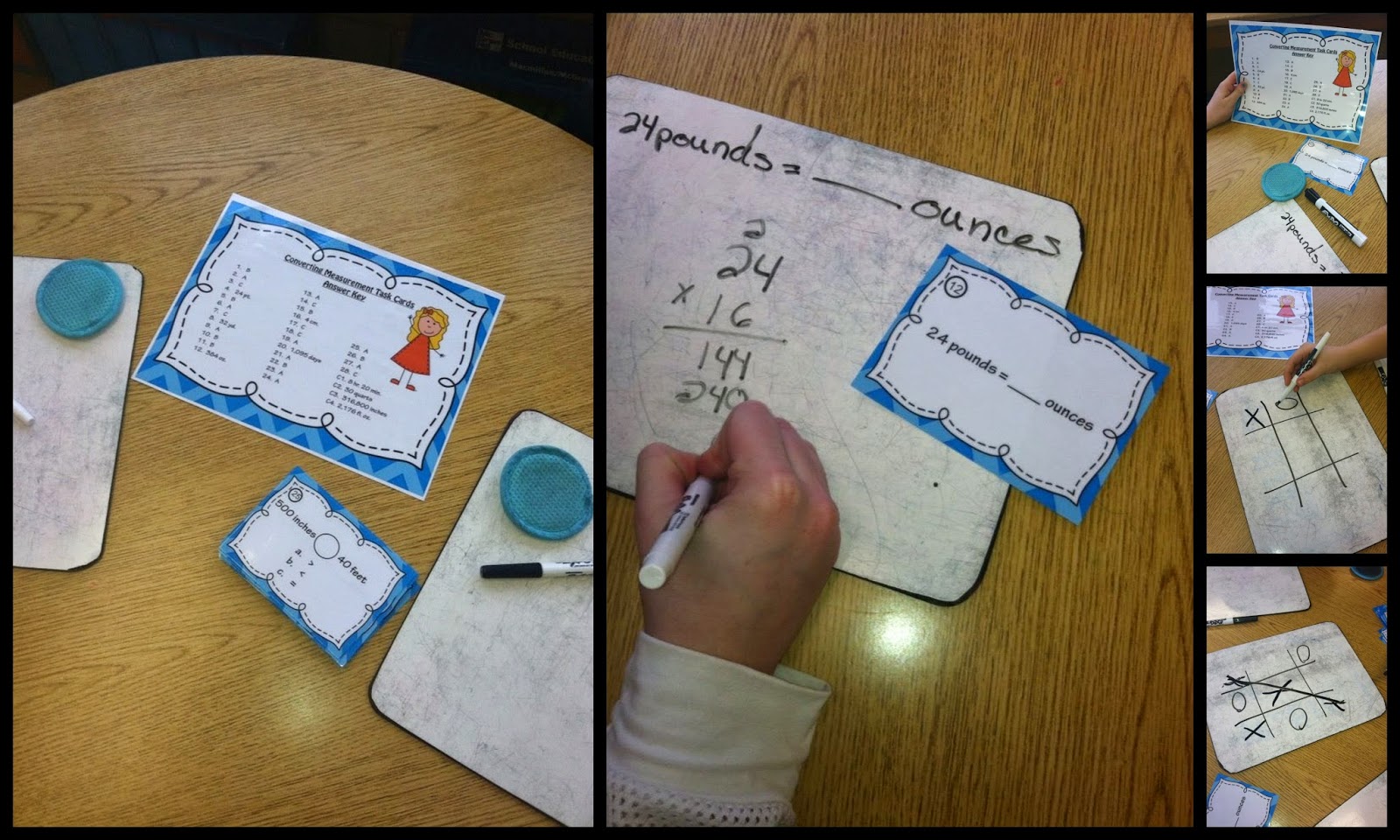
2.  Use Any Board Game.  Students love games like Connect 4, checkers, and Jenga.  So let them earn a turn in the game by correctly answering a task card question. First, provide dry erase boards, markers, and erasers for each player.  (I find it easiest to have students working in pairs.) Then, give them a stack of task cards for whatever skill you are reviewing. Have students work independently on their own dry erase boards to solve the problem on the top card.  Then, have them turn over the answer key and check it.  If they are correct, they get to take a turn in the game. If not, they lose a turn.  Students really do love this practice method!


3.  Use Building Blocks.  This is similar to the board game strategy, but students earn turns to add a block to their own tower by correctly answering the question.  Whoever has the tallest tower at the end is declared the Task Card King or Queen for the day.  :D


4.  Use Plastic Cups.  Who knew that a stack of plastic cups, a pile of task cards, and a couple of dry erase boards and markers could bring so much fun to a classroom? I simply used stacks of cups from my Power Tower math games (so students ignore the math facts written on the cups...) and watched as my fifth graders worked through task cards to earn turns to add cups to their tower.  Whoever builds the tallest, prettiest, most original (you choose the word of the day) is the winner!


5.  Tic-Tac-Toe: 3 in a Row.  Same dry erase board procedure with any set of task cards, but with students earning turns on a tic-tac-toe board.  Perfect for a quick activity or center!

6.  Exit Tickets.  How easy is this?  Keep a pile of task cards handy for use as exit tickets. Either project one onto your screen (if you're lucky enough to have a document camera....still wishing here) or copy it onto the board or chart paper. Have students solve it on paper and turn in on their way out the door.  This gives you a quick picture of which students understand the skill.

7.  Morning Work. Have students choose any 2 or 3 task cards from a pile or pocket chart and complete them as soon as they enter the room in the morning.  This is perfect for those unused minutes before class begins.

8. Scoot.  Any discussion about using task cards would not be complete without the mention of Scoot, a whole-class activity which keeps students moving and staying on-task.  You can read more about how to play this game in this BLOG POST at Appletastic: Blossoming in Fifth Grade. 

Granted, there is a place for regular paper and pencil test prep worksheets and practice. I do try to keep in mind, though, that these are children, not little test-taking robots, that I am teaching. I'm sure the great and powerful Ozzes of the testing world have forgotten this, but I have vowed to not forget it. Ever. Therefore, I will continue to make learning as fun, interesting, and engaging as I possibly can. Task cards are a perfect tool for this goal!

Looking for Task Cards to use in your classroom?  Check out these nifty Math Task Card and Poster Sets by Shelly Rees.  They are Common Core aligned and perfect for test-prep, practice, and review! This is just one example of many!


 If you'd like to make your own, you may be interested in her Editable Task Card Templates.  They're super-easy to use!

Wednesday, February 4, 2015

Rockin' the Test with Less Prep and Less Stress!

Tests. Assessments. Exams.  Do you dread these words as a teacher? Do your students shiver with fear at the thought of them?  Then, by all means, you need to stay tuned to Upper Grade Memoirs all throughout the month of February!  Our group of seasoned teachers have some great blog posts coming your way to help you and your students not only survive the test, but ROCK THE TEST!


Here is a sneak peek at what is in store during the month of February at UGM:

  • Apps and Websites to Maximize Test Review Time
  • Playing Games to Help Prepare for the Big Day
  • Easing the Stress of Testing for Students
  • Using Scootpad for Test Prep
  • Overcoming Test Anxiety
  • Reading Skills Jeopardy
  • Test Prep with Task Cards
  • And Much More!
That's not all!  To help 2 lucky teachers de-stress, there will be a fun giveaway later this month. Make sure you are following along, so you don't miss out!  (Hint......  Bull's Eye ;) )


Saturday, January 31, 2015

Top 10 Books for Building Emotional Intelligence and Vocabulary

According to Wikipedia: "Emotional intelligence is the ability to monitor one's own and other people's emotions, to discriminate between different emotions and label them appropriately, and to use emotional information to guide thinking and behavior".


Below is my top ten list of books that will help your students build emotional intelligence. 

#1. 
For the worry wart!

I also found this cute video that teaches kids how to use deep breathing to relieve anxiety:


#2. 
A quick fun read. 

I always strive to get my students to include emotion words to their writing as a way of adding voice to their stories.  What I love about this book is that it shows students creative ways to present their writing. For instance, the word "scared" is written in 'shaky' writing,  and words like "silly" and "excited" are written in a whimsical way!  This book is a great way to build students' emotional vocabulary while teaching the 6 +1 traits of writing!

#3. 
I love this book!! It's a great tool for teaching students how to deal with their anger!!


#4. 
This one made my top 10 list because of the art ... it's so creative. I'm thinking you could create a class book inspired by "How Are You Peeling?".  You could get students to bring in various foods from home and photograph & label the 'emotions' they see in the food that they bring in. 
That would be fun!!


#5. 
Anger is such an intense and confusing emotion (for kids and adults alike).  Books that teach kids how to express anger in a healthy way deserve to be on this list!


 I will admit, I might be a bit biased about the next 5 books, because... well.. I created them... but I can tell you from experience that they really do help students develop the vocabulary needed to label emotions accurately. 

 I always find that when my students write in their journals, they tend to use the same old boring words like "I was happy",  or "It made me feel sad", and so on.  When I get them to use a thesaurus to "spice up" these over-used words, they often struggle to select the exact synonym(s) to fit the context. So, I decided to create my own books to help students understand the varying shades of meaning for emotion words.  

Here are some of the Picture Thesaurus books in my collection.   

#6. Sad

A closer look:


Each page is illustrated to depict the varying shades of meaning for a given word. So, for the above example, there are 27 synonyms for sad, but they are grouped into 7 different contexts (or shades of meaning).  This helps students label their emotions more accurately when writing.

Click HERE to take a closer look at my Sad book.  


#7. Angry.

This one is a FREEBIE for you to try! Click HERE to try it out!


#8. Happy

Click HERE to see my happy book.


#9. Scared

Click HERE to see my Scared Picture Thesaurus


#10. Nervous

This last one is not sold separately and is only available in my Picture Thesaurus Bundle or in my Emotions Bundle.

Click HERE to see the Picture Thesaurus Bundle.
Click HERE to see my Emotions Bundle. 


There you have it... My TOP 10 books for building emotional vocabulary!!


Friday, January 30, 2015

Top 10 Fluency Resources


Every year, teachers in my state have to set goals for our PDP's, or Personal Development Plans. After reading my School Improvement Plan and analyzing data from previous classes, I decided that I wanted to help my students become more fluent readers. So, I've spent a lot of time researching what fluent readers look like, as well as ways to help students read more fluently. I would like to share what I've learned with you.

Here are my top 10 fluency resources. They are in no order - just 10 things that I, or colleagues from my school, are currently using in the classroom.

1. FCRR - Florida Center for Reading Research


This site is amazing - and it's free, too!! There are so many great resources on this site. Simply go to their site, click on "For Educators," then click on "Student Center Activities." Once there, you can choose which grade level you would like to have resources for. Choose the grade level you want, then scroll down to see all of the resources they have. You have instant access to fluency resources, as well as comprehension activities, phonics, and vocabulary! This site is amazing! All of the pictures below are activities that I have found on this site. The boy in the red (right) is doing an activity called "Speed Read," where he sees how many words he can read in a minute. The yellow sailboats (left) is an activity called "Fluent Phrasing" where the student has to read sentences that are in phrases. The first word of the sentence is alone on the top line. The next line has two words of the sentence. The third line has three words of the sentence, and so on. 


2. Weekly Fluency Passages


I created these passages for students in my classroom. I wrote ten, nonfiction reading passages for students to practice their fluency at home. I give a passage out on Friday. Students must read the passage three times during the week - once a day on three different days. They graph their words per minute on the back of the passage. They get excited when they see the bar increase each time! A parent must sign it to show me that they are reading to someone. On the Friday that it is due, students must write a paragraph to summarize the passage. I found that early on, students were just trying to get higher numbers each time - they weren't reading for meaning. Since I have started requiring them to write a summary each week, I have found that they are reading more closely, yet still increasing their WPM (words per minute). I have created three sets of these passages - all include ten, nonfiction passages. If you're interested in purchasing them for your classroom, please click on the pictures below to be taken to my site.


3. Hashtag Fluency by Jenn Jones at Hello Literacy


#awesomeproduct #thekidsloveit #oneofmyfavoritepurchases #youmusttrythisatschool - I L-O-V-E this product!! My students love it, too! Jenn Jones, from Hello Literacy, is amazing! She took hashtags, the language of today's students, and turned it into a fluency tool! Students have ten lists of hashtag phrases. They have one minute to read each list. There is a chart provided to record the date that students master each list. There are also super cute certificates to give students as they complete a list. I copied these booklets for students to use at school and to take home to study. There is more to her product. She has games that students can play to increase their fluency. There are also fluency strings. I have several students that are working so hard to master these, too! In fourth grade, students must be at 130 words per minute at the middle of the year. In order to pass the lists of strings, students must get at least 130 WPM to move on to the next list. This product is so popular in my classroom that the students invited our security officer to come into the classroom to see them in action! If you don't have this product, I highly recommend it!!

I organize the different components of this product using a tote bag. Inside the bag, I have files that I, along with my students, have easy access to. When students want to practice, they just grab the bag and a partner. I have a master binder that includes all of my fluency resources. The "Hashtag Fluency" product has it's own tab, of course! The student pictured has passed all of her hashtag fluency lists. She has moved on to the fluency strings. Seriously - you must check out this product!


4. Readers' Theater


I love using readers' theater to help students become more fluent readers! Students love working together, and most love to act, so plays are the perfect resource! There are so many ways to tie this into your curriculum, too. I have scripts about mythology, animals, and rocks/minerals - all which are a part of my state's standards. Readers' Theater scripts are the perfect way to teach your standards, help students become more fluent readers, and keep your lessons interesting. My newest find are the Partner Plays written by Deb Hanson. My students love them!! I printed them, put them in page protectors, put them in pocket folders, and labeled them. The students love them, of course, and asked if they could act them out the first day that I introduced them!


The girls in the picture are reading a script from Deb Hanson's Partner Plays - Character Traits Scripts. This one is called "Partner Work." These scripts are perfect for increasing student fluency. They are also great for introducing character traits vocabulary, which many of my students struggle with. 


5. Fluency Phones (or Whisper Phones)


Have you ever seen these? Have you ever used them? They are awesome little fluency tools!! You can buy them online or make them yourself. Either way, they are wonderful! Students hold them like a phone and talk. That's it. The students will whisper, too, because the sound is amplified so well. If they don't, they are only hurting their ears. You can have your entire class of students using these at the same time and it will not give you a headache!


I cannot take credit for these, and I cannot remember where I originally found the idea to make them. But, I can direct you to a site where you can learn about them. There is a great post on Teacherific in Second Grade's blog. You can find it here. You can purchase them ready-made at Lakeshore Learning. Click here to view their whisper phones. 


6. Fluency Task Cards


It's important to give your students plenty of opportunities to practice reading fluently. However, they don't always have to read long passages. That's why I created these Animal Facts Fluency Cards. There are 24 cards - all about animals - for students to read. They can record their reading in two ways. They can record how many words they can read in one minute. If they finish the card early, they would reread it until time was up. An alternative would be to time the students to see if they can decrease how long it takes them to read it each time. In my product, I have included cards for both of these strategies. These can be practiced individually, with partners, or with small groups. These cards have true facts with some challenging vocabulary, yet are short enough to be manageable. 


7. Achieve the Core


I can't believe I didn't know about this site sooner. Their site is crammed full of resources - and they are free! You'll need to register to have access to everything, but it's still free! I don't know about you, but I have an extremely hard time finding quality fluency resources for upper grades students. If you have this problem, then look no more! There are tons of passages for upper grades students. You can click here to view the fluency packet for the 4-5 grade band. You will find 40 fluency-building passages, comprehension questions, and key vocabulary. Do you teach older students? Click here to find 41 fluency-building passages, comprehension questions, and key vocabulary for the 6-8 grade band. What about high school students? They have have these amazing resources available for students in grades 9 and 10. This site is just too good to miss!  


I asked our literacy specialist for her recommendations on high-quality resources. This was her newest, greatest find and she was excited to share it with me. She uses the 6-8 grade band passages for her sixth grade students. They read passages daily and chart their progress on charts. She said they love it, too! The picture to the right is an example from her classroom. This student is obviously making great progress. Go check out this resource today!


Grades 4-5

Grades 6-8
Grades 9 & 10


8. Daily 5 and CAFE


Many of you have probably heard about the Daily 5 and the CAFE. The name "Daily Cafe" merges the two programs. The idea behind these programs comes from Gail Boushey and Joan Moser, also known as "The Two Sisters." These sisters have combined their classroom experiences to create an amazing way to help students love reading. Teachers at my school have done book studies using both of these books. Many teachers in our school have implemented these programs and have seen amazing results. 

The Daily 5 program allows children five choices when reading. These are: 

  1. Read to self
  2. Read to someone
  3. Listen to reading
  4. Work on writing
  5. Word work
The CAFE system allows teachers to deliver instruction during the Daily 5 time. There are four components to the CAFE system:
  1. Comprehension
  2. Accuracy
  3. Fluency
  4. Expand Vocabulary
When these two resources are combined, stronger readers are produced. I highly recommend that you read the books written by "The Sisters." In the books you will find implementation strategies, resources, and even scripts to read from. While Daily 5 and CAFE look different in every classroom, the routines, expectations and procedures look the same. Click here to purchase the Daily 5 book. Click here to purchase the CAFE book. You can also check with your media coordinator and public library to see if these books are available to check out.


9. Fluency Fans


Fluency fans are a fun way for students to become stronger readers. As I stated earlier, fluency passages are a great resource. Students need strong, longer passages to become better readers. However, sometimes shorter is good, too. I created fluency fans as another tool for students to use to increase fluency. This particular set of fluency fans were created based on Fry words. Dr. Edward Fry listed the top 600 words that fourth grade students would most likely encounter when reading. He took these 600 words and broke them into six lists. In these six lists, he created phrases that students should be able to read. My product has six lists, each based on the 100 words he recommends. I wrote the phrases on small strips so that they make a fan of words. Students can choose a list and read the phrases, counting how many phrases they can read correctly in a minute. Students should read these "fans" at least three times. Their goal should be to read more phrases correctly each time. I made these this week and my students are so excited for me to add them to our fluency toolkit! If you're interested in purchasing a set for your classroom, please check out my store here. Below are some pictures of completed fans.


10. Fluency Timer


I like to conference with students about their reading as often as possible. We talk about what they are reading and we set reading goals. I keep a binder of fluency passages at my desk. During our conference, students read a short passage to me and I record them using this app - "Fluency Timer." It is wonderful! It records the student reading and automatically times them for one minute. After the minute, it gives you the option to save the recording. I save it under the student's name. You can go to the library on the app and it will show you each file, along with the date and time that you recorded them. After I save the files, I let the students listen to themselves read. If they are worried about others hearing them, all they do is plug their earbuds into my phone or iPad. Then it's completely private. The reason this is such a powerful tool is because it allows the students to hear what they really sound like. They often don't catch their mistakes when reading aloud. But when they hear it recorded, they are very quick to recognize their errors. Every student that I have recorded has been surprised by their recording. Some decide they need to read faster; others, slower. They can hear if they are skipping words or substituting words. Sure, I can tell students by observations and give suggestions, but it's very powerful when they can determine these things for themselves. I feel like this is time well-spent.

This app is available in the iTunes app store. You can get the free version or pay a small amount to be able to save multiple files. I am not very familiar with the Google Play store, but when I did a search, I found many similar apps. 


I hope I have introduced you to some new, fun ways to help your students become more fluent readers. What fluency-building activities do you do in your classroom? How do you build more fluent readers? I would love to hear your thoughts! Please comment below! 
Monica


Related Posts Plugin for WordPress, Blogger...